February-March 2023
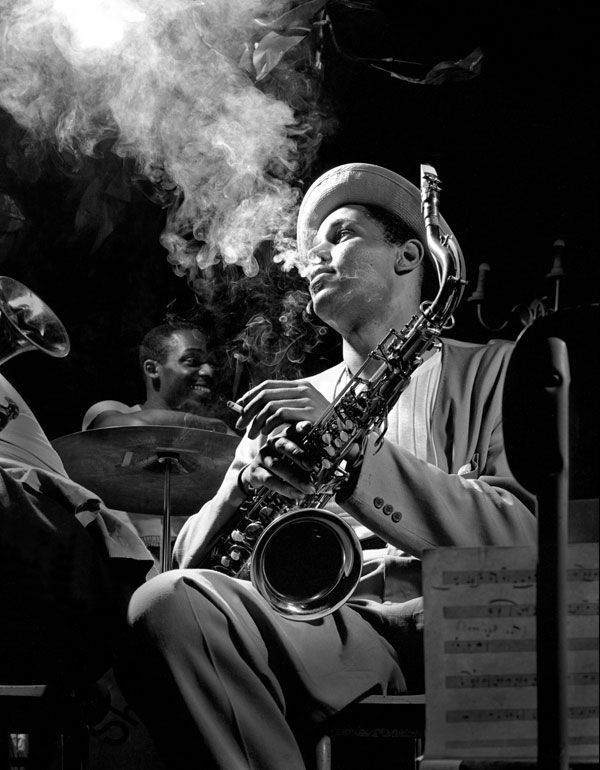
The gigantic #jazz #saxophone player Dexter Gordon was born #OnThisDay tomorrow, February 27 1923, just 100 years ago.
You may know him through this classic 1948 photograph by Herman Leonard.
To celebrate this musician, I’ll embark tomorrow into a 10-day tour into his music, as a saxophone player and as a composer.
Follow the hashtag #DexterGordon100 !
I start my journey into Dexter Gordon’s music at one of the pivotal moments of his career, with the first tune of his classic hard bop album, GO, recorded in 1962 for Blue Note. Butch Warren is on bass, Billy Higgins on drums, Sonny Clark on piano, himself on tenor saxophone.
This is the first tune of that recording, the only composition by Dexter, Cheese Cake
Enjoy how he transforms from a simple melody to sophisticated improvised arabesques…
“Cheese Cake”, Dexter Gordon quartet, GO, 1963
Here is the music sheet, in case you like looking at such stuff. You’ll see that this seemingly simple melody hides a more complex structure.
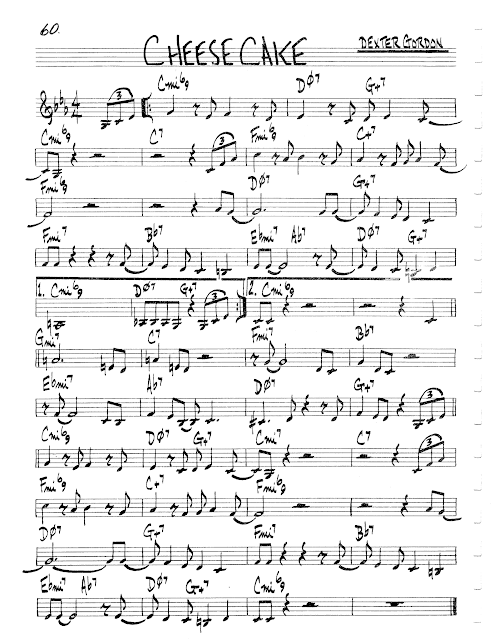
The basic line is a 4-bar pattern first played in Cmi, and then transposed in Fmi, followed by an 8-bar bridge that descends tone by tone. This piece is repeated once more (it is hard not to notice the A natural on bar 15), and we pass to another 8-bar bridge that uses a repeated II-V-I progression. Then back to the initial 16-bar theme, just played once.
After 4 recordings for Blue Note in 1962-1963, Dexter Gordon left the US for Europe, first destination Paris.
Today’s tune was recorded in 1964, with an American line up, but the Danish bass player Niels-Henning Ørsted Pedersen (NHOP) : Art Taylor on drums, Donald Byrd on trumpet and Kenny Drew on piano. He would then settle in Copenhagen for 14 years
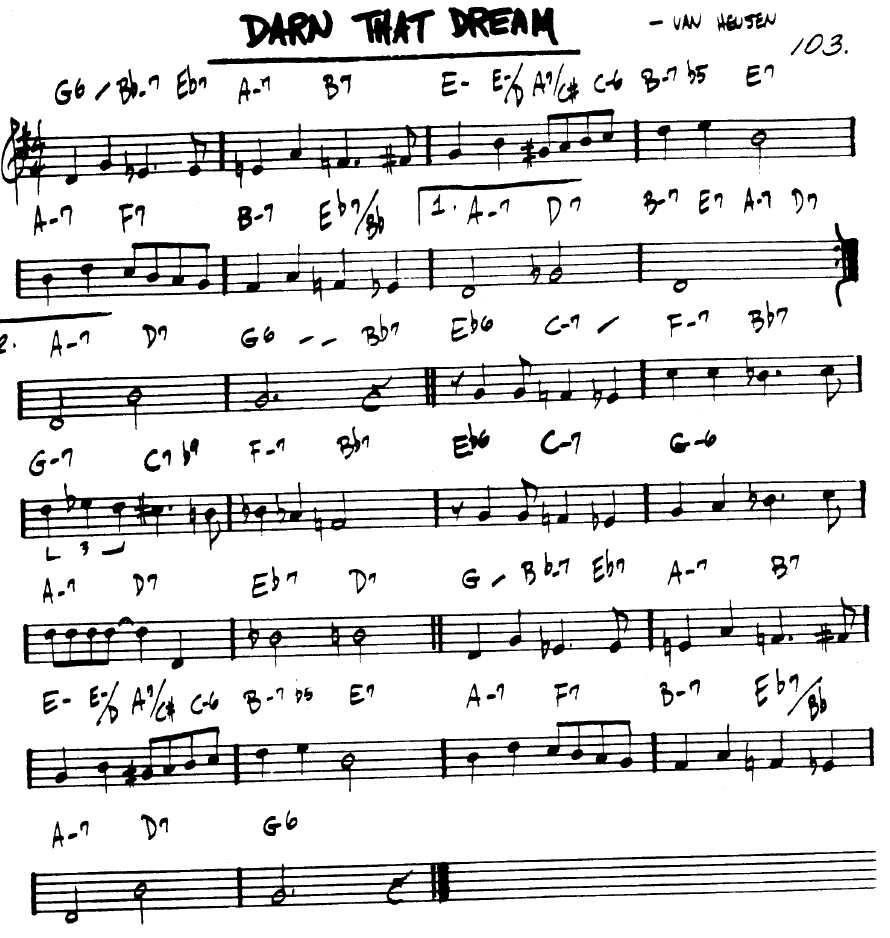
From that recording One Flight Up, a splendid ballad: “Darn That Dream”.
“Darn That Dream”, Dexter Gordon quintet, One Flight Up, 1964
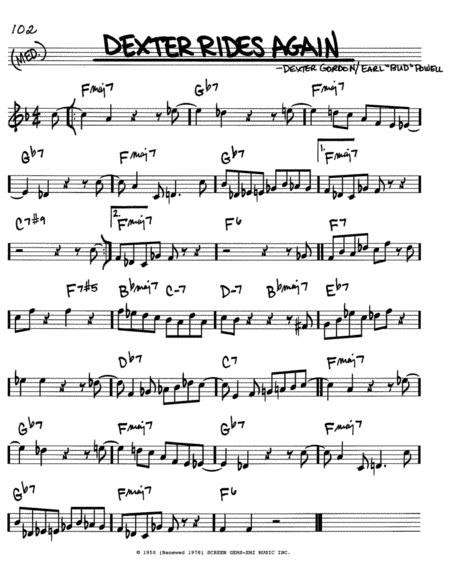
We go back to early recordings by Dexter Gordon as a leader. For this tune recorded in January 1946 and that’ll give the 1947 album its name, Gordon is accompanied by Leonard Hawkins on trumpet, Curly Russell, Bud Powell on piano, and Max Roach on drums! This is pure be bop… Both Gordon and Powell are credited as composers…
“Dexter Rides Again”, Dexter Gordon quintet, Dexter Rides Again, 1947
When I write that it’s pure bebop, have a look! An almost non-existent melody built on powerful riffs rhythmic strokes (the repeated dotted quarter/quarter that starts the theme, at bars 1, 2, its variant at bars 5 and 18, and the quarter/quarter that closes it at bar 32 — already hinted by the piano at multiple places such as bar 16, and also that initiates the short drum solo on the bridge), the mostly F harmony and the II-V-I bridge, as if the whole role of the composition is to leave these agile improvisers the space they need to show their talent, enough space so that they can even have some fun, from the title of the tune to the quote of Jingle Bells at 1:27!
Dexter Gordon’s career consisted in several periods, and every time I play one of the four Blue Note recordings he made in 1961-1962, they seem to me as exceptional: with an incredible taste, he alternates hard swinging post-bop tunes and gorgeous ballads.
I am certain you will shiver at that one, with Freddie Hubbard on trumpet, Horace Parlan on piano, George Tucker on bass and Al Harewood on drums.
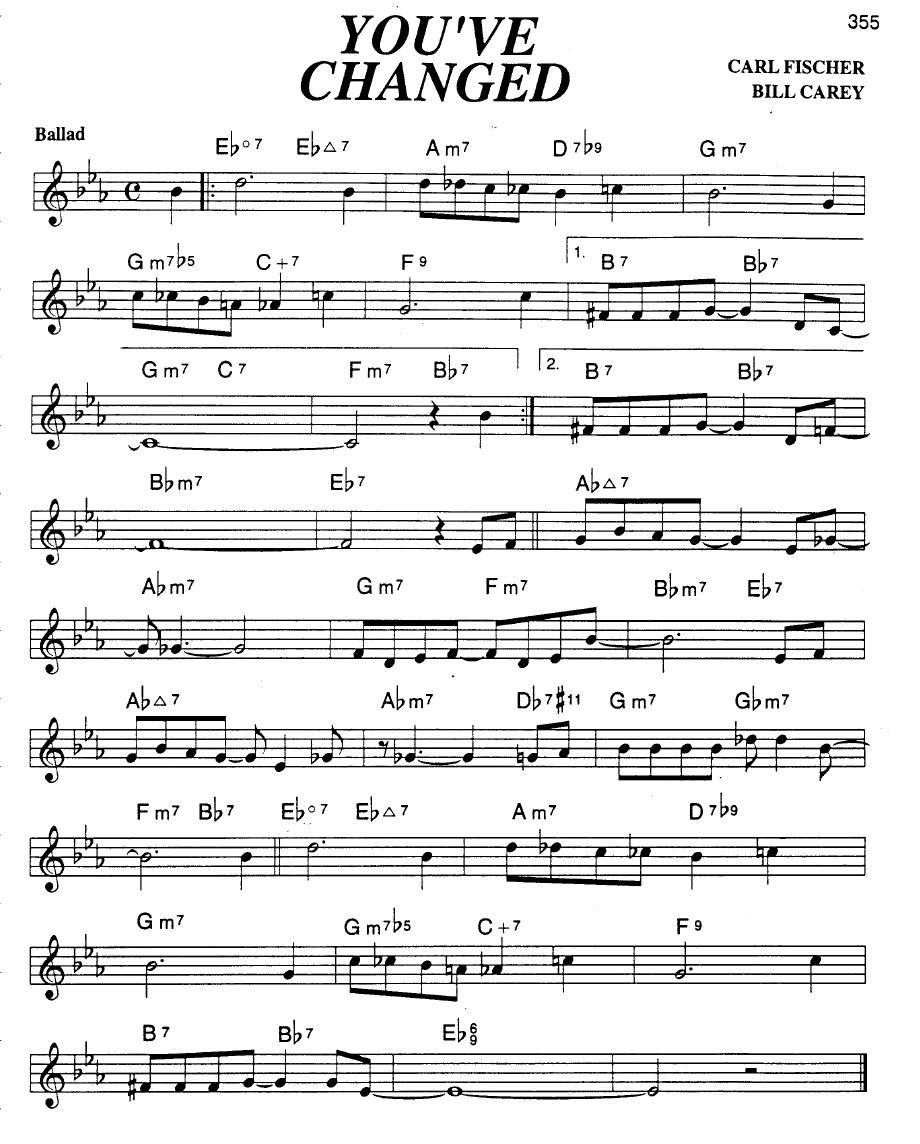
A Carey/Fischer composition, “You’ve Changed”.
“You’ve Changed”, Dexter Gordon, Doin’ Allright, 1961
From the first improvised notes, supported by a delicious Hubbard’s chromatic descent, you can hear that this will be a great tune. And looking at the music sheet helps appreciating the ornemental delicacy of Dexter Gordon. There’s so much sadness in this interpretation — or maybe, after the dark decade he had suffered, it may just be Gordon’s faith that he can finally start a new life: he looks so proud on the cover picture, sitting on this horse-drawn carriage at Central Park.
During the 14 years he spent in Denmark, Dexter Gordon played with either local musicians (such as the immense Niels-Henning Ørsted Pedersen, or the drummer Alex Riel) and American musicians who had moved there too, such as Kenny Drew on piano. For today’s tune, recorded live, in July 1973, at Montmartre Jazzhus in Copenhagen, the four musicians are joined by the alto saxophonist Jackie McLean.
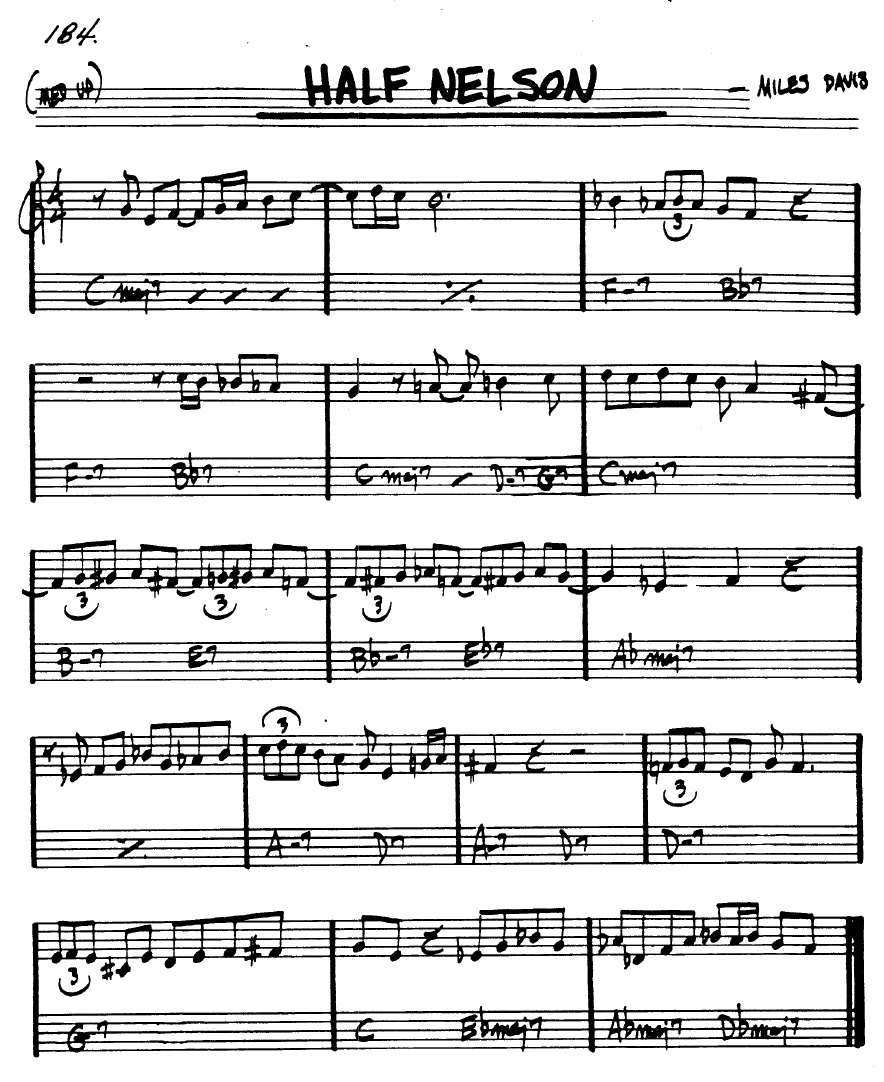
“Half Nelson”, Jackie McLean & Dexter Gordon, The source, vol. 2, 1974
Based on the chords of Lady Bird, a 1939 composition by Tadd Dameron, Half Nelson is a 1947 composition of Miles Davis. (Probably a good way to avoid to pay copyrights, particularly if you don’t care too much in the melody itself). Its long phrases, each one starting at a different place of the bars, sounding like they’re improvised, make this tune a be bop classic. Here, it’s kind of a pretext for the five musicians to share their forceful energy, though never loosing track of the music.
In early April 1969, Gordon returned to New York City for two recording sessions with Barry Harris on piano, Buster Williams on bass and Albert “Tootie” Heath on drums, some tracks featuring James Moody on tenor saxophone. This gave matter for two albums, “Tower of Power!” and “More Power!”.
From the second album, this peaceful Meditation composed by Antonio Carlos Jobim. Be it powerful or tender, Dexter Gordon’s saxophone never misses the soul.
“Meditation”, Dexter Gordon, More power!, 1969
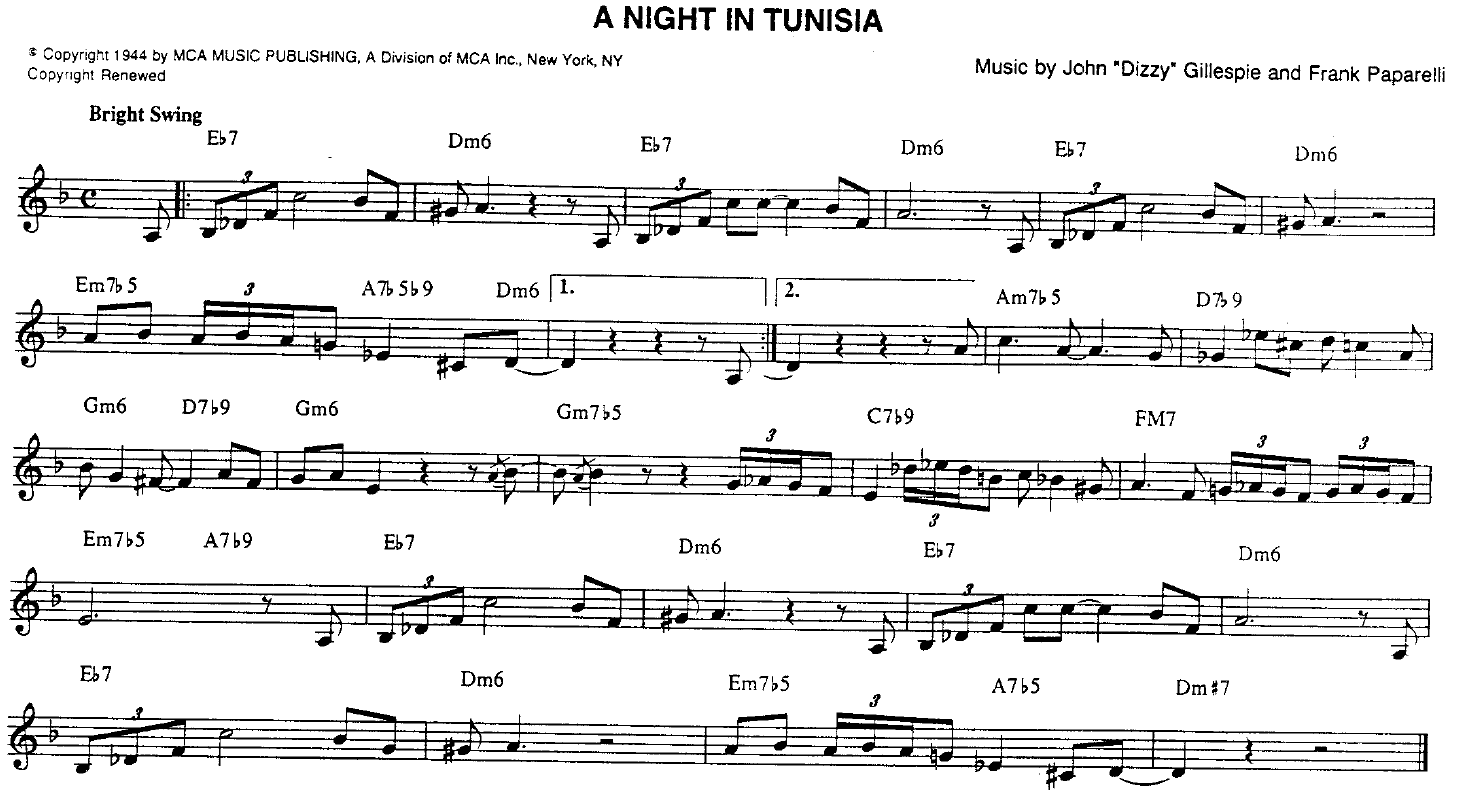
We listened to a quiet bossa nova yesterday, and today is the time of a musically strange AABA composition by Dizzy Gillespie and Frank Paparelli, where the A is supposed to have an African influence and the B is deliberately played in swing style…
Listening to a few concerts of the 60s by Dexter Gordon, I observed that he always played such a tune. So today is the day of a Night in Tunisia.
Recorded in Paris, for Blue Note, with the Parisian dream team of that time, Bud Powell on piano, Pierre Michelot on bass and Kenny Clarke on drums. Yes, Powell and Clarke are American, but they moved early to Paris (Powell in 1959, Clarke in 1956), and both are crucial figures of be bop. Clarke is even the one who switched the time keeping from hi hat to the ride cymbal, giving rise to what we now feel is the sound of classic jazz…
As explained by Georges Paczynski in his Histoire de la batterie de jazz (volume 2, pages 80-83), Afro-Cuban rhythms became a central part of bebop jazz, propelled by Dizzy Gillespie’s band, with drummers like Clarke, Roach, Blakey, and the Cuban percussionist Chano Pozo.
In today’s tune, note Kenny Clarke’s chorus, from 5:56 on, playing a solo on the 32 bars (you can hear him chant what he plays!), listen how his solo doesn’t come from nowhere, but has some faithfulness to the actual melody — and hear him going back to the Afro-Cuban rhythm on the cymbal (mostly playing its bow, with accents on its bell).
(One thing remains mysterious to me, though, is why these rhythms were associated with the idea of Africa, whose rhythms are definitely different…)
As explained by Georges Paczynski in his Histoire de la Batterie Jazz (volume 2, pages 80-83), Afro-Cuban rhythms became a central part of bebop jazz, propelled by Dizzy Gillespie’s band, with drummers like Clarke, Roach, Blakey, and the Cuban percussionist Chano Pozo.
In today’s tune, note Kenny Clarke’s chorus, from 5:56 on, playing a solo on the 32 bars (you can hear him chant what he plays!), listen how his solo doesn’t come from nowhere, but has some faithfulness to the actual melody — and hear him going back to the Afro-Cuban rhythm on the cymbal (mostly playing its bow, with accents on its bell).
(One thing remains mysterious to me, though, is why these rhythms were associated with the idea of Africa, whose rhythms are definitely different…)
To help you start the week (I know, it’s only Monday…), here is a sweet ballad that Dexter Gordon recorded in 1975 accompanied with a “strings and things” orchestra (Ed Thigpen on drums…), in arrangements by Palle Mikkelborg.
Composed by Vincent Youmans, this tune appeared in the 1929 musical Great Day, with lyrics by Billy Rose and Edward Eliscu: “More than you know, Man of my heart, I love you so…”
“More Than You Know”, Dexter Gordon Strings and Things, 1975
As I wrote a few days ago, Afro-cuban rhythms were part of the jazz music of that epoch, and Dexter Gordon also composed a few tunes in that mood. First recorded in 1962, in the album A Swingin’ Affair, this is a live version of a Dexter Gordon composition, just for the sake of seeing Albert Tootie Heath smiling when he starts the basic clave at an incredible speed. Niels Henning Orsten Pedersen is on bass, Kenny Drew on piano. On that night of July 1967, the heat must have been high in Denmark! (The whole concert is amazing, it’s too bad the recording starts in the middle of Dear Old Stockholm…)
“Soy Califa”, Dexter Gordon quartet, Live in Denmark, 1967
In 1986, Dexter Gordon was the leading actor in the Bertrand Tavernier movie Round Midnight. He played a role of a saxophonist who tries to launch his career by moving to Paris, while struggling with alcohol and drugs. Based on Francis Paudras’s book, La danse des infidèles (Dance of the infidels, the title of a Bud Powell composition), the movie is inspired by the lives of Lester Young and Bud Powell, who settled in Paris at some time, and died soon after they returned back to Paris.
This movie features a lot of live music, in particular, this terrific version of Body and Soul, in which it seems Dexter Gordon has condensed all of his art into 4 sublime minutes. He is accompanied by great musicians, Herbie Hancock on piano, John McLaughlin on guitar, Pierre Michelot on bass and Billy Higgins on drums. (The last two were old musical companions of Gordon’s, and McLaughlin is playing incredibly out of his usual style…)
“Body and Soul”, Round Midnight, movie by Bertrand Tavernier, 1986
As noted in the comments of the video, Francis Paudras appears at 1:56, the guy who’s recording the concert…
This file stems out a series of toots on Mastodon, that was unthreaded day after day from February, 26, 2023 on, under the hashtag #DexterGordon100. You can also get it on Markdown or PDF formats.