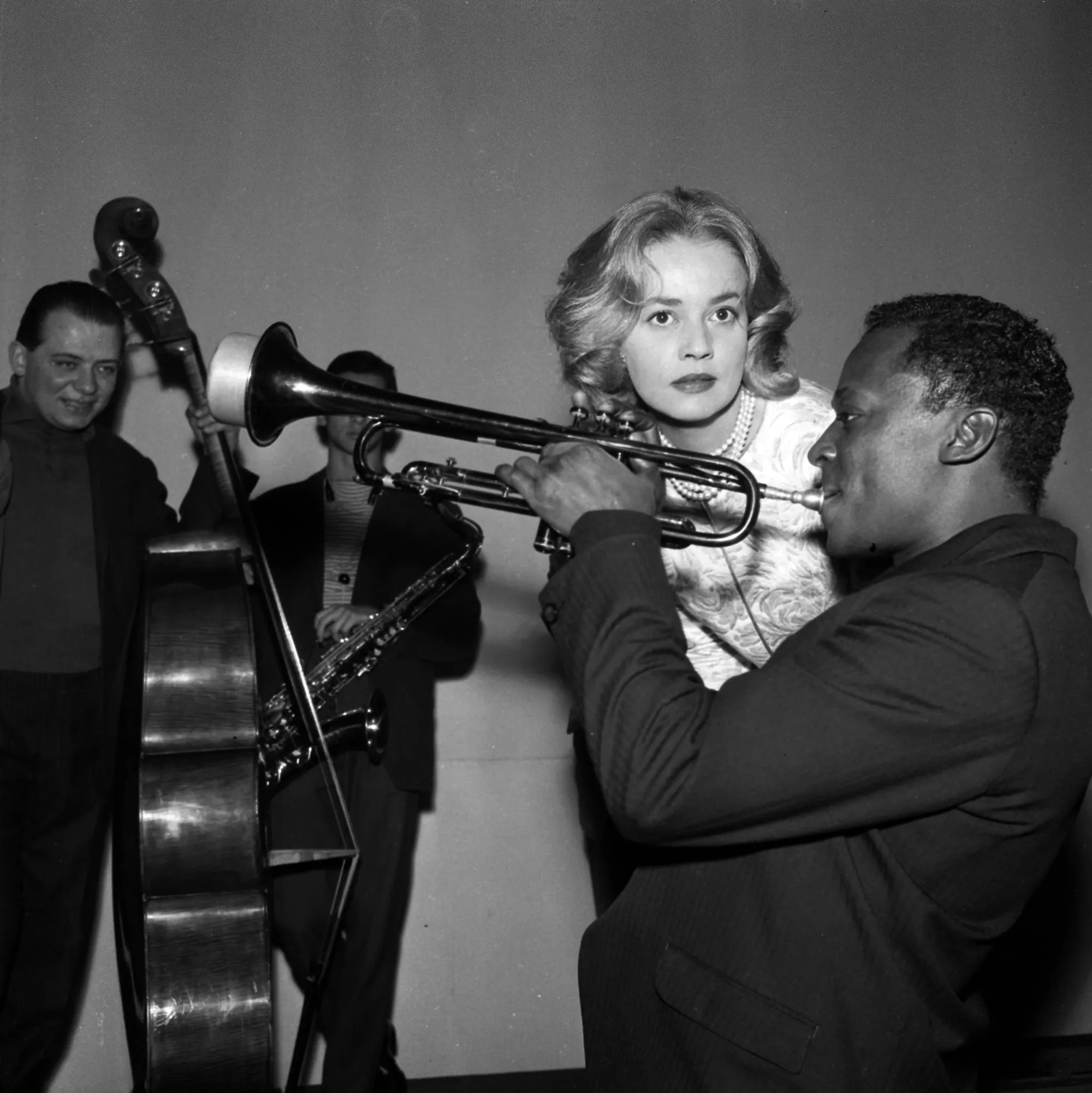
May-August 2026
Rip Sonny Rollins, a gigantic saxophone player, who died on the eve of Miles Davis’s 100th birthday. To celebrate their music in sadness,
“My Old Flame” (Arthur Johnston), Dig, 1956
To celebrate the works of this musician whose 100th birthday was yesterday, let’s listen to this melancholic improvised piece that opens Louis Malle’s 1957 movie Ascenseur pour l’échafaud (Lift to the scaffold). The atmosphere is quiet but already somber, and the drama will unfold soon.
With Miles Davis on trumpet, we have René Urtreger on piano, Barney Wilen on tenor saxophone, Pierre Michelot on bass, and Kenny Clarke on drums.
“Générique”, Ascenceur pour l’échafaud, 1958
Today, I go back to a 1954 tune recorded with Sonny Rollins, actually a composition of the saxophone player.
Percy Heath is on bass, Kenny Clarke on drums, Horace Silver on piano, Miles Davis on trumpet and Sonny Rollins on tenor saxophone.
After a characteristic afro-cuban introduction, this tune turns into pure hard bop. It’s hard to realize that the rhythm section had founded the Modern Jazz Quartet a few years before. Recorded in June 1954.
“Airegin” (Sonny Rollins), Bag’s Groove, 1954
Tony Williams drives this tune at a ferocious pace, Herbie Hancock is on piano, Ron Carter on bass, Wayne Shorter on saxophone. No mystery that Miles Smiles…
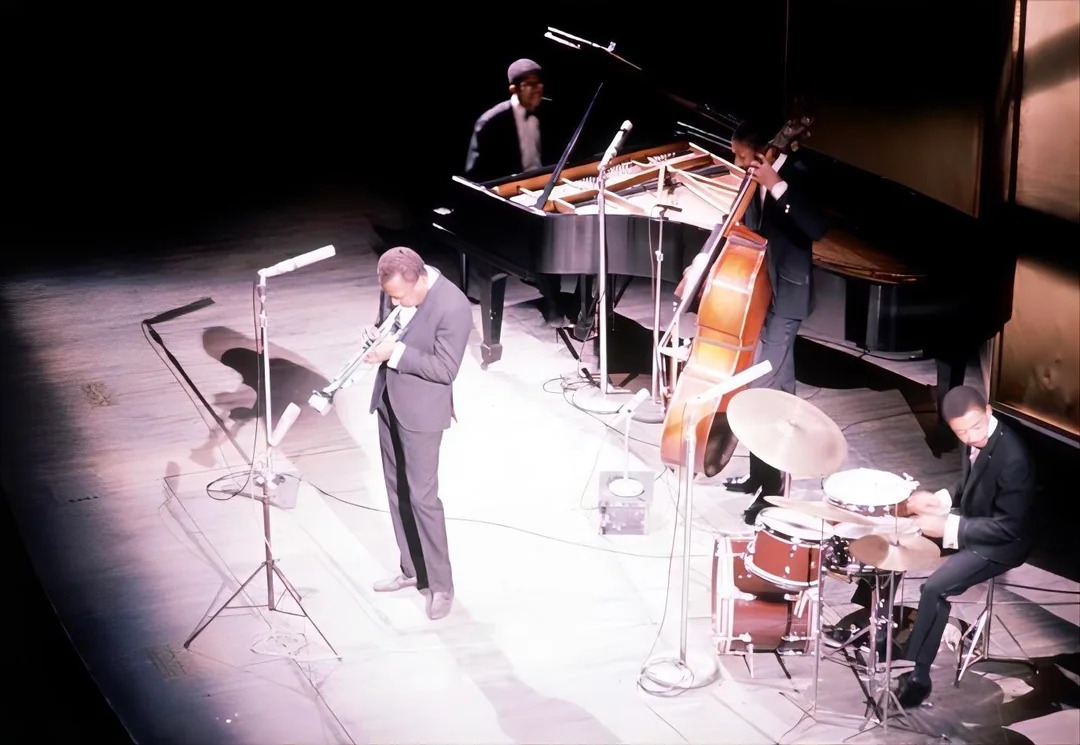
“Freedom Jazz Dance” (Eddie Harris), Miles Smiles
Still in quintet, but several years before yesterday’s piece.
Stockholm, 1960. With Miles Davis on trumpet, we have John Coltrane on tenor saxophone, Paul Chambers on bass, Jimmy Cobb on drums and Wynton Kelly, piano.
“All blues”, Live in Stockholm, 1960
Yet another quintet, but we depart from the piano/bass/drums/sax/trumpet: here we have vibraphone (Teddy Charles) and trombone (Britt Woodman), and no piano. Miles Davis is on trumpet, of course, and Charles Mingus (bass) and Elvin Jones (drums) form the rhythm section. This was recorded in 1955.
“Nature Boy” (eden ahbez), Blue Moods, 1955
We are now in 1958, with Miles’s great sextet on the album “58’ Miles featuring Stella by Starlight”. But we won’t listen to the tune that stands on top of the cover, at least not today.
Cannonball Adderley is on alto saxophone, John Coltrane on tenor saxophone, Paul Chambers on bass, Bill Evans on piano, and Jimmy Cobb on drums.
“Love for Sale” (Cole Porter), 58’ Miles feat. Stella by Starllight, 1958
Back to the beginnings of Miles Davis’s career, 1947, when he held the trumpet in Charlie Parker’s quintet. Max Roach is on drums, John Lewis on piano, and Nelson Boyd on bass.
One of the early quintets of Miles Davis, with Red Garland on the piano (before he was fired because, so it is said, of his use of substances that made him not show up at gigs).
This comes from a series of 4 recordings from 1956 (Relaxin’, Steamin’, Workin’, Cooking’) that Miles had to do to fulfill his contract with Prestige, before he left for Columbia. His coworkers, John Coltrane on tenor saxophone, Philly Joe Jones on drums and Paul Chambers on bass, take on their jobs seriously.
Listen how the pianist starts with lines that sound more like a pop song than a jazz tune.
“It never entered my mind” (Richard Rodgers), Workin’ with the Miles Davis Quintet, 1959
From a 1957 big band recording, with arrangements by Gil Evans. Yet another kind of Miles.
While Miles Davis played several tunes composed by Thelonious Monk, they only did one recording together, and it seems that it didn’t happen so well between the two musicians, except that the music that came out of it is beautiful.
Today is a 1958 recording, at Newport. John Coltrane is on tenor saxophone, Nat Adderley on alto saxophone, Jimmy Cobb on drums, and Bill Evans on piano.
“Straight No Chaser” (Thelonious Monk), Miles Davis At Newport 1958
Let’s jump to 1967. With Tony Williams on drums, Herbie Hancock on piano, Wayne Shorter on saxophone and Ron Carter on bass, Miles Davis recorded Sorcerer. The song that holds the album’s title is a composition by Herbie Hancock. Witchcraft, indeed.
“The Sorcerer” (Herbie Hancock), Sorcerer, 1967
A 1924 composition by Abel Baer.
Recorded live in 1960 in Stockholm, with Sonny Stitt on tenor saxophone, Paul Chambers on bass, Jimmy Cobb on drums, Wynton Kelly on piano.
“June Night (Abel Baer), In Stockholm, 1960
We all know that song through the 1937 Disney animated movie, a song that rapidly became a jazz standard.
Wynton Kelly (piano), Hank Mobley and John Coltrane (tenor saxophone), Paul Chambers (bass) and Jimmy Cobb (drums) give life to this tune.
Apparently, Coltrane didn’t know the tune, he came late to the recording session and had to improvise instantly his short chorus.
“Someday My Prince Will Come” (Frank Churchill), Someday My Prince Will Come, 1961
Is it jazz? is it rock? Does it matter? Miles Davis celebrates the achievements of Jack Johnson, an American boxer who, at the height of the Jim Crow era, became the first black world heavyweight boxing champion.
Together with Herbie Hancock on keyboards, Michael Henderson on bass, Steve Grossman on saxophone, the aggressive electric guitar of John McLaughlin, the heavy drumming of Billy Cobham, and the shrieks of Miles Davis’s trumpet make this tune a moment of pure energy.
“Right Off”, A Tribute to Jack Johnson, 1971
I tried to avoid it until now, but maybe it’s a good time to listen to some piece from Kind of Blue.
There’s a poem by Langston Hughes, from The wary Blues:
I would liken you
To a night without stars
Were it not for your eyes
I would liken you
To a sleep without dreams
Were it not for your songs.
The night is falling on Paris, the sky is dark blue. We’re wary of the day that came, of the one that’s coming. Everything’s blue.
“All Blues”, Kind of Blue, 1958
Thirty years after Kind of Blue, Miles had turned his back several times to the music that he had created and that had made him famous.
Marcus Miller (bass, keyboards), Kenny Garrett (alto saxophone), Omar Hakim (drums), Joe Sample (piano) set up the foundations for this funky ballad.
“Amandla” (Marcus Miller), Amandla, 1989
Back to 1963, with a bizarre recording made of 3 relatively quiet ballads with a standard rhythm section, and 3 up tunes with extraordinary musicians Tony Williams and Herbie Hancock (Ron Carter is on bass on the whole album). The first tunes are not that bad, maybe we’ll listen to one of them one day, but we need more energy to enter the week-end.
“Seven Steps To Heaven” (Victor Feldman, Miles Davis), Seven Steps to Heaven, 1963
This was recorded in April 1949 in NYC, in a larger ensemble than what we’re used to.
Alto Saxophone – Lee Konitz Baritone Saxophone – Gerry Mulligan Bass – Nelson Boyd Drums – Kenny Clarke French Horn – Sandy Siegelstein Piano – John Lewis Trombone – J. J. Johnson Trumpet, Leader – Miles Davis Tuba – John Barber
Three sessions of that period were grouped in the album The birth
of the cool. 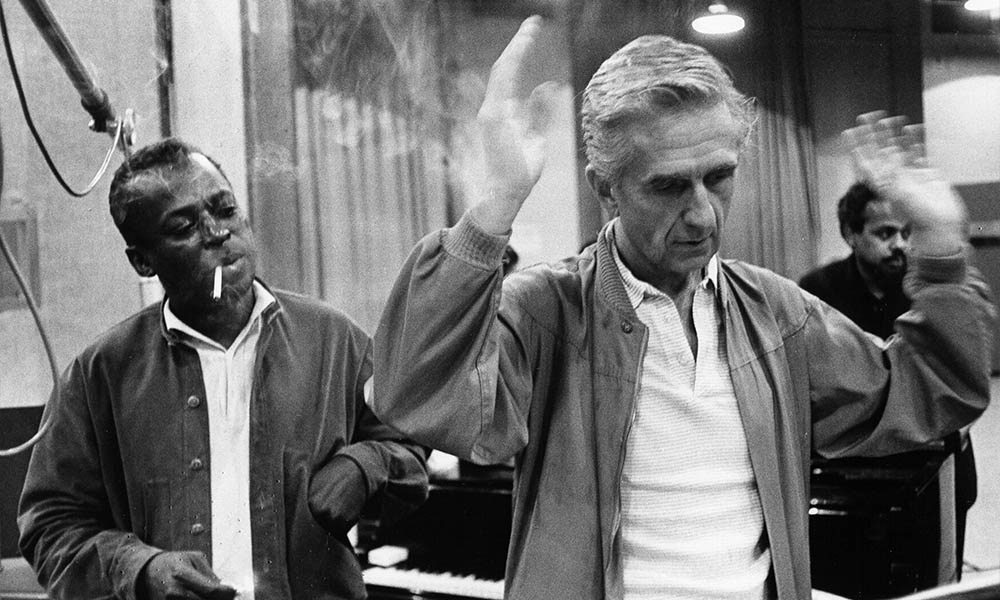
The composer is Cleo Henry. This is the maiden name of Miles Davis’s mother, but is used as a pseudonym for the collaboration of Miles Davis and Gil Evans, with whom Miles would make several albums for large ensemble. The arrangement is due to Gil Evans.
“Boplicity” (Cleo Henry), The Birth of the Cool, 1949
With the band he had gathered a year ago for In a Silent Way, Miles goes on exploring rock rhythms, but doubles on the rhythmic section: two electric pianos (Chick Corea, Joe Zawinul), two electric basses (Dave Holland, Harvey Brooks), two drum sets (Don Alias, Jack DeJohnette), plus Juma Santos (Jim Riley) on congas.
On top of that, add Miles Davis on trumpet, Wayne Shorter on soprano saxophone and Bennie Maupin on bass clarinet, and John McLaughlin on electric guitar.
A long musical trance.
“Miles Runs the Voodoo Down”, Bitches Brew, 1969
Let’s spend a few days listening to various versions of one song that Miles Davis’s bands magnified and that all amateur musicians enjoy botching up.
This is the 1958 version from 58 Miles, featuring Bill Evans, Cannonball Adderley, John Coltrane, Paul Chambers, Jimmy Cobb.
“Stella by Starlight” (V. Young), 58 Miles feat. Stella by Starlight, 1958
Recorded live in Kyoto, 1964. With Sam Rivers on saxophone, Herbie Hancock on piano, Ron Carter on bass, Tony Williams on drums.
“Stella by Starlight” (V. Young), Live in Kyoto, 1964
Early 1964, George Coleman played the saxophone in Miles Davis’s quintet, but he left in May. Miles hired Sam Rivers following the suggestion of Tony Williams, but he didn’t stay long.
This version is also from 1964, as the one of yesterday, but it features the standard quintet gathered by Miles at this time : Herbie Hancock, Ron Carter, Tony Williams (as yesterday) and George Coleman on saxophone.
Recorded Live at the Philarmonic.
“Stella by Starlight” (V. Young), My Funny Valentine. Miles Davis in Concert, 1964
There is a YouTube video where Herbie Hancock recalls the first time he played for Miles. At a time where Herbie didn’t even think he would ever play with Miles, the latter asked him to “play something” and Herbie Hancock, by fear of playing something up, started that ballad, Stella by Starlight.
I wonder how that very little moment led Miles to revisit this song of his 1958 repertoire for his new quintet.
Early 1964, George Coleman played the saxophone in Miles Davis’s quintet, but he left in May, apparently to play with Lionel Hampton. Miles then hired Sam Rivers following the suggestion of Tony Williams, but Rivers didn’t stay long. Followed a time where jazz critics wrote that possibly Miles Davis wouldn’t hire a saxophonist again. And then came Wayne Shorter who would not only play for him, but also bring a number of compositions that would re-define the sound of the quintet.
“Stella by Starlight” (V. Young), Miles in France, 1963 & 1964
One more version of Stella by Starlight This is one is taken from a later concert, 1965, at the Chicago Plugged Nickel.
Miles starts with a chorus that comes out of nowhere. Slowly the rhythm section gives a clear beat and the slow ballad turns into a light swing piece, and then the chase begins, faster and faster, driven by a steady bass/drums rhythm (Ron Carter and Tony Williams are incredible !). You may get hints of the melody, maybe you won’t, so that when Wayne Shorter starts his own chorus, after 6 minutes of improvisation, the chase may go on. Until, God knows why, things suddenly get quieter again. Only after a small piano chorus by Herbie Hancock will we hear a distorted version of the theme played by Miles Davis. And the tune ends almost as it started — in silence…
“Stella by Starlight” (V. Young), Live at the Plugged Nickel, 1965
To celebrate the solstice, and heal our bodies in the midst of an unusual heat wave that strikes part of Europe, let’s dive into those “Summer Nights”.
This quiet ballad was one of the two tracks left over from Seven Steps to Heaven, and has been published in the album Quiet nights. Together with Miles Davis on trumpet, we have Ron Carter on bass, Frank Butler on drums, Victor Feldman on piano, George Coleman on tenor saxophone.
“Summer Nights” (H. Warren), Quiet Nights, 1963
We’re officially into summer, the heat wave still hurts, so No no no, the living isn’t easy.
Nevertheless, this arrangement by Gil Evans of Porgy and Bess is a masterpiece. Paul Chambers and Philly Joe Jones bring a steady pulse while Gil Evans’s orchestra (3 French horns, 3 trombones, 4 trumpets, 2 flutes) add riffs. Julian Adderley is on saxophone, but I couldn’t distinguish him.
“Summertime” (G. Gershwin), Quiet Nights, 1963
It’s still very hot, so let’s keep the Summer vibe.
Once upon a Summertime, a French (coocookidoo) song by Michel Legrand, Eddie Barclay, and original lyrics by Eddy Marnay with the title La valse des lilas. The English lyrics were written by Johnny Mercer.
Arranged by Gil Evans, and performed with his orchestra for the album Quiet Nights. It is interesting to note how Evans doesn’t mind a shrill intervention at 2:00 in the middle of a superbly quiet moment. Also, while the original tune was definitely in 3/4 time (it’s a valse!), their version is played in 4/4.
“Once Upon a Summertime” (M. Legrand, E. Barclay), Quiet Nights, 1963
Do you know about another famous jazz song that was initially composed in 3/4, but whose most famous version is played in 4/4?
— “Fly me to the moon”. The legend says that Frank Sinatra couldn’t sing in 3/4 hence Quincy Jones wrote a 4/4 arrangement for him.
Hanging out in a hot summer night at a lake beach,
“Flamenco Sketches” (M. Davis, B. Evans), Kind of Blue, 1959
Let’s play word chain and listen to part of another album that Miles Davis made in 1960 with Gil Evans: Sketches of Spain.
There is no song with that title, but the last track, “Solea”, starts with a plaintiff movement that perfectly suits the mood of a continent afflicted by (previously unusual but doomed to be usual) heat.
“Solea” (G. Evans), Sketches of Spain, 1960
Let’s go on with the word chain?
This is a song from Bitches Brew: we leave Gil Evans’s orchestral nuances for a more rock infused jazz tune. Many musicians are on the stage, though, including those playing instruments that are usually not repeated: 3 electric pianos (Joe Zawinul, Larry Young, Chick Corea), two drum sets (Jack DeJohnette and Lenny White), one bass (Dave Holland) and one electric bass (Harvey Brooks). Benny Maupin is on bass clarinet, Wayne Shorter on soprano saxophone.
“Spanish Key” (M. Davis), Bitches Brew, 1970
Frelon Brun is the first track of this 1969 album Filles de Kilimanjaro. The woman on the album cover is Miles Davis’s newly married wife, Betty Mabry, and the French titles is supposed to add an exotic touch to this album which marks the transition from this post-bop period to the coming electric/fusion period.
“Frelon Brun”, Filles de Kimimanjaro, 1969
Back to early music by Miles Davis, namely to Birth of the Cool. (Yes, it’s the beginning of the end of the heat wave — until the next one.)
Rouge is a composition by John Lewis who also wrote the arrangement for this group of nine musicians. Kenny Clarke is on drums, Nelson Boyd on bass, John Lewis on piano, Gerry Mulligan on baritone saxophone, Lee Konitz on alto saxophone. We also have Bill Barber on tuba, Sandy Siegelstein on French horn, and J. J. Johnson on trombone.
The recording of this album took place in January and April 1949, following a live concert in September 1948. Reactions were mixed, Count Basie stating that he liked it but “didn’t always know what they were doing” while the New Yorker critic Winthrop Sargeant insisted that “it is not really jazz”. This album was only released in full in 1957 and was then recognized as an “important direction of modern chamber jazz”.
“Rouge” (J. Lewis), Birth of the Cool, 1949
After “Frelon Brun” (“Brown Hornet”) and “Rouge”, let’s have a color sub-thread.
This is from 1955. Oscar Petitford is on bass, Philly Joe Jones on drums and Red Garland on piano.
“Green Haze”, The Musings of Miles, 1955
Continuation of the colored thread.
This is a 1965 version, with Tony Williams, Ron Carter, Wayne Shorter, and Herbie Hancock.
“On Green Dolphin Street” (B. Kaper), Live at the Plugged Nickel, 1965
From Kind of Blue…
“Blue in Green” (M. Davis, B. Evans), Kind of Blue, 1959
Continuing the color-thread, back to be bop with : Out of the Blue
(Jackie McLean is on alto saxophone, the track was recorded before he left the recording studio, it is said, out of disagreement with Miles Davis.)
I wanted to continue the colored thread by noting that black is a color, but I remembered of the book Three wishes. Baroness Nica von Koenigswarter was fond of jazz and of jazzmen, and she asked them to name three wishes. She collected those wishes in a book.
Miles Davis’s answer was clear and simple : - 1. to be white - 2. to be white - 3. to be white
Nevertheless, this is “Black Satin”.
“Black Satin”, On the Corner, 1972
More black. An angry version of Masqualero (a Wayne Shorter composition) from Black Beauty — Live at the Fillmore West.
“Masqualero” (W. Shorter), Black Beauty — Live at the Fillmore West, 1970
I’ll go on with a few compositions by Wayne Shorter. They’re less obviously melodic, more abstract, and this changed the sound of Miles Davis’s quintets. I don’t know why that one is named after Carlo Collodi’s main character.
This is the main version from the album Nefertiti. Tomorrow we’ll listen to the alternate take, which is played at half tempo and sounds completely differently.
“Pinocchio” (W. Shorter), Nefertiti, 1967
Pinocchio again, but at a much slower tempo. The speedy and nervous melody is turned into a sad lament.
On the Internet, one can find some people wondering how the album Nefertiti was recorded. Is there a possibility that they tried this tune slowly at first? Or, in the opposite, did they just tried it slow to see what would come out of it.
As far as I can tell, later recordings of that theme were played fast — at least this is so for the one recorded by Weather Report (still with Wayne Shorter).
“Pinocchio” (W. Shorter), Nefertiti (1967)
We go on with another composition by Wayne Shorter. That one has became a standard of modern jazz, that Wayne Shorter recorded first under his name in 1966 for Adam’s Apple. Its quality may explain why Miles Davis, often jealous of the successes of his fellow musiciens, decided to record it altogether.
This version is a live recording (with pictures) from 1967. Miles takes it fast and nervous, but observe how Wayne Shorter starts his chorus by having the music almost stop. Tony Williams’s playing is also remarkable: while he is still driving the tune at uptempo, the silences he brings allows Wayne Shorter’s phrasing to develop, from quietness to forcefulness, and eventually disappears under Herbie Hancock’s notes.
“Footprints” (W. Shorter), Live in Sweden, 1967
“Prince of Darkness” is another composition by Wayne Shorter — this time from the album Sorcerer. It starts with a hard-bop melody, although sustained by a quite different drumming. And when Miles’s chorus starts, we clearly are in some new place.
“Prince of Darkness” (W. Shorter), The Sorcerer, 1967
Yet another composition by Wayne Shorter.
This one is taken from Bitches Brew, and with its two electric pianos, sounds quite differently from last day’s quintet.
Twenty years later, Wayne Shorter will give an even more funkier mood to this tune by recording it with Carlos Santana !
“Sanctuary” (W. Shorter), Bitches Brew, 1969
In 1968, Miles Davis had already recorded a version of that tune with “the” quintet (Wayne Shorter is on saxophone, Herbie Hancock on piano, Ron Carter on bass and Tony Williams on drums) supplemented by George Benson on guitar. It was only released in 1979 in the album Circle in the round.
“Sanctuary” (W. Shorter), Circle in the round, 1979
I need a quiet and melancholic tune to prepare us to the weekend. This is another composition by Wayne Shorter, that gave its title to the 1967 album, Nefertiti.
A simple and sad motive is repeated almost endlessly. The essentially only variations come from rhythmic interventions from Tony Williams on drums and Herbie Hancock on piano.
“Nefertiti” (W. Shorter), Nefertiti, 1967
Still from Nefertiti, this is yet another Wayne Shorter composition. A melody that just consists of a harmonic movement and a one-measure riff that is just sung three times on the 16-bar piece.
Isn’t it amazing that one can do beautiful music with seemingly so little material?
Also listen how Tony Williams’s drumming sustains and influences differently the successive choruses.
“Fall” (W. Shorter), Nefertiti, 1967
Still in the exploration of Miles Davis’s quintet playing compositions by its saxophone player Wayne Shorter, and after a few minimalist compositions, I go back to the first recording of Miles Davis’s “second great quartet”, E.S.P., recorded in 1965.
A melancholic melody that conceals its underlying 3/4 pulse. Shorter plays both expositions of the theme, at the beginning and the end of the piece.
“Iris” (W. Shorter), E.S.P., 1965
More of Miles Davis’s bands with Wayne Shorter at the writing desk.
Limbo is a short theme in an unusual form, 8 1/2 bars, probably more a two-phrase riff than a melody, with a rich harmonic structure underneath.
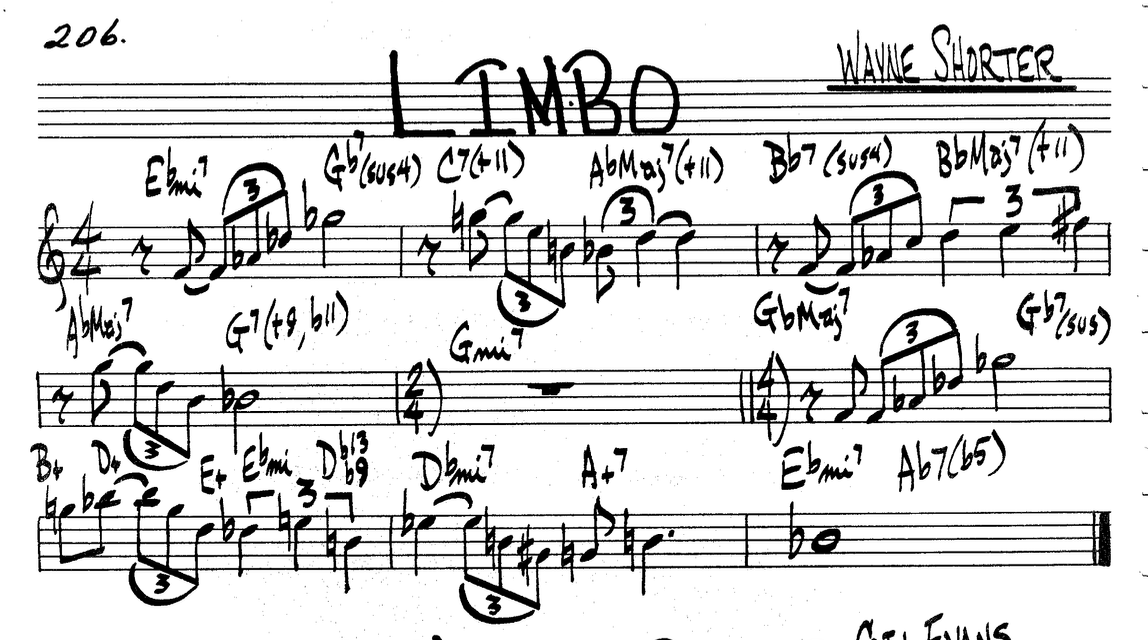
And with that plain material, after a cool post-bop introduction on the piano, the quintet finally releases fire. With Tony Williams as the leading incendiary. After choruses by Davis and Shorter, Hancock impose his relaxed initial mood again, and can’t seem to be bothered by Williams’s incitements.
“Limbo” (W. Shorter), The Sorcerer, 1967
Halfway of this exploration of Miles Davis’s music, on the day where the French soccer team lost their semifinal against Spain, and on Bastille Day.
A live version, recorded April 1959, with video, of the first great quintet performing “So What”.
Paul Chambers on bass, Jimmy Cobb on drums, Wynton Kelly on piano, John Coltrane and Cannonball Adderley on saxophones, with trombone players doing chit chat.
Yesterday’s tune was planned, but it is necessary to honor Spain after their victory in semifinals yesterday night.
From Sketches of Spain, of which I’ve already streamed a few songs, here is an arrangement by Gil Evans of a ballet piece by Manuel de Falla, “Cancion del Fuego Fatuo”.
“Will o’ the wisp” (M. de Falla, arr. G. Evans), Sketches of Spain, 1958
This file stems out a series of Mastodon threads, that was unthreaded day after day from May 26, 2026 on. You can also get it on Markdown or PDF formats.
There is also a YouTube playlist that collects all of these recordings.