Math 130, Fall 2015
Information for students
- Syllabus
- DSP students should speak to the instructor as soon as possible, even if you don't have a letter yet.
-
Guidelines on what to do if you think you may have a conflict between this class and your extracurricular activities.
In particular, you must speak to the instructor before the end of the second week of classes. - Academic honesty in mathematics courses. A statement on cheating and plagiarism, courtesy of M. Hutchings.
- Policy on absences for tests and midterms.
- How to get an A in this class

Textbook
The required text for this course is The Four Pillars of Geometry by John Stillwell. You can download a copy of this book for free on campus through the UC library (link) (if that link doesn't work, search for the book at lib.berkeley.edu)This book is a wonderful introduction, but a little too easy for us, so there will be lots of required supplementary readings supplied by the instructor.
We will also use some excerpts from Hartshorne's Geometry: Euclid and Beyond Euclid, I recommend this to students wishing to go further. It can also be downloaded on campus (link)
Week-by-week list of readings and activities
(will be updated throughout the course)- Sept. 27th: A review of Hartshorne's Geometry: Euclid and Beyond Euclid by D. Henderson.
Week 2: Euclid's constructions with straightedge and compass.
- Stillwell, chapter 1 (and a little of chapter 2).
- Activity: Euclid: the game
- online version of Euclid's elements, with comments. You were given the definitions and postulates as a handout.
Week 3: Parallels, and the theory of area
- Stillwell, chapter 2
- Short reading: Commentary on Euclid's method of superposition, from Hartshorne. (despite the weird page numbering, these pages are in order!)
- 111 ways to prove the pythagorean theorem
- Handout: Proposition 35 and 38 from the online version of Euclid's elements
- Euclid's construction of the regular pentagon, from Hartshorne. Compare with your construction from HW2.
- Constructible n-gons, followed by a quick introduction to field extensions. From a wonderful book "Conjecture and Proof" by M. Laczkovich.
- (Optional) videos of Prof. Eisenbud and Gauss' 17-gon: video 1 video 2
- (Optional) Viete's construction of the 7-gon
- Reading from Hartshorne: sections 6-8
Week 6: Hilbert's axioms, continued.
- Reading from Hartshorne: sections 8-10
Week 7: Midterm exam on Tuesday, Intorduction to projective geometry on Thursday. Discussion of independent project.
- Reading to be done by the beginning of Week 8:
How to win the lottery with projective geometry
an excerpt from ``How not to be wrong" by Jordan Ellenberg. -
Midterm solutions
Midterm problem statements (with point values)
Week 8: Projective geometry
- Selection from Ellenberg, see above
- Reading from Stillwell, chapter 5.
- Just for fun: anamorphic drawing.
And a very sophisticated understanding of projective transformations in OK GO's music video The writing's on the wall.
Week 9: More projective geometry
- Selections from Stillwell, chapter 6
Week 10: Transformation groups, plane and spherical geometry.
- Stillwell, chapter 7
-
Quaternions and rotations
More than you wanted to know, but you might be especially interested in the practical advantages of using quaternions over ordinary matrices.
Week 11: Introduction to hyperbolic geometry
- More on quaternions and 4-dimensional geometry: Hypernom the game. Explained here
- Stillwell, chapter 8 up to 8.4
- Mobius transformations: video by Douglas Arnold and Jonathan Rogness,
with explanation here
And an interactive applet by Terry Tao.
Weeks 12-13: More hyperbolic geometry; practice for presentations
- Reading from Stillwell, chapter 8.
- Many tilings of hyperbolic space by Jos Leys
- movies of isometries of hyperbolic space by Goodman-Strauss
- Here is a template that you can use to make this Escher tessellation on a wrinkly-paper model of hyperbolic space!
- Notes on area of hyperbolic triangles from the end of the last class.
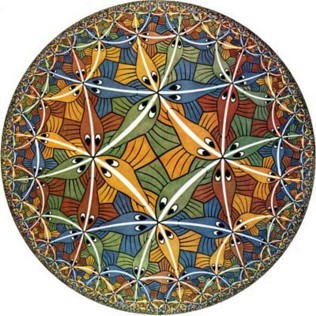
Week 14-15: Student presentations on independent projects.
Week ∞ (not part of the course, but on the horizon).
Some geometry books that you might like to read in the future
- The shape of space by J. Weeks. A wonderful introduction to geometry and topology and the question "what is the geometry of our universe?" There is a short (and less mathematical) movie inspired by the book here .
- Three-Dimensional Geometry and Topology by W. Thurston. This book begins with an introduction to the hyperbolic plane, and then goes much further...
Homework
Weekly homework assignments will be posted here.- Problem set 1 due Tuesday, September 8
selected solutions - Problem set 2 due Tuesday, September 15
selected solutions - Problem set 3 due Tuesday, September 22
selected solutions
See above for links to the readings.
- and... Just for fun (not to hand in) challenge problem on equidecomposability. Due never, but tell me if you solve part b!
- Problem set 4 due Tuesday, September 29
selected solutions - No homework due Tuesday, October 6 (you have a midterm!)
- Problem set 5 due Tuesday, October 13
selected solutions - Independent project assignment
Some suggestions for topics - Problem set 6 due Tuesday, October 20
selected solutions - Problem set 7 due Tuesday, October 27
selected solutions - Problem set 8 due Tuesday, November 3
selected solutions - Problem set 9 due Tuesday, November 10
selected solutions - Problem set 10 due Tuesday, November 24.
Note: there was a typo in Question 3.c), which has now been corrected.
The formula given there is a special case of the Gauss-Bonnet theorem which says that angle defect (in our case, 2pi - exerior angle sum) is equal to the area of a polygon multiplied by the curvature of the space.
Hyperbolic space has constant negative curvature, in our calculaions we're using curvature -1.
triangle paper
selected solutions to HW 10
- Resources for your independent project:
General advice on how to get started writing
Guidlines for peer review of a paper
Grading rubric for oral presentation and written report
- Presentation schedule
- Review for the final exam
Your final exam takes place on Wed, December 16, 3pm-6pm, in the usual classroom. I will hold office hours on Monday and Tuesday, times to be announced by e-mail.
Worksheets
Worksheets that were given in class- Worksheet 1 from September 3
- Worksheet 2 from September 17
- Worksheet 3 from September 29
- Worksheet on anamorphic (perspective based) writing from October 13
- Worksheet 4 (Pappus theorem) from October 22
- Worksheet 5 (Rotations) from October 29
- Worksheet 6 (Tiling the plane with reflections) from November 12
- Resources for your independent project:
(also here are the videos mentioned in the problem set: video 1 video 2
Note: the last problem should say "where k and n are relatively prime". This has been added to the statement!

