Click for some instructions/background
Click on "Toggle labels", and the dimension of each node will be displayed.
They form a vector $\bd$, with one integer for each node.
A fission graph $\Gamma$ equipped with a dimension vector $\bd$
(and some complex parameters we will ignore here) determines two algebraic symplectic moduli spaces:
$\bullet$ An additive (De Rham) moduli space $\mathcal{M}^*(\Gamma,\bd)$
$\bullet$ A multiplicative (Betti) moduli space $\MB(\Gamma, \bd)$
The Stokes-Birkhoff-Riemann-Hilbert correspondence
yields a (family of) transcendental maps $\mathcal{M}^*(\Gamma,\bd) \to \MB(\Gamma, \bd)$.
Both moduli spaces have the same complex dimension and the additive moduli space is (noncanonically) isomorphic to
the Nakajima quiver variety of $\Gamma$
with dimension vector $\bd$.
The moduli space dimension is given by the formula:
$\dim(\mathcal{M}^*(\Gamma,\bd)) = \dim(\MB(\Gamma, \bd)) = 2-(\bd,\bd)$
where the inner product $(\,\cdot\,,\,\cdot\,)$ is given by the (Kac-Moody) Cartan matrix $C$ of the graph:
$(\bd,\bd) = \bd\cdot C\bd$.
In turn the Cartan matrix is $C=2.\Id-A$ where $A$ is the adjacency matrix of $\Gamma$.
Click the nodes to increase their dimensions (right click will reset).
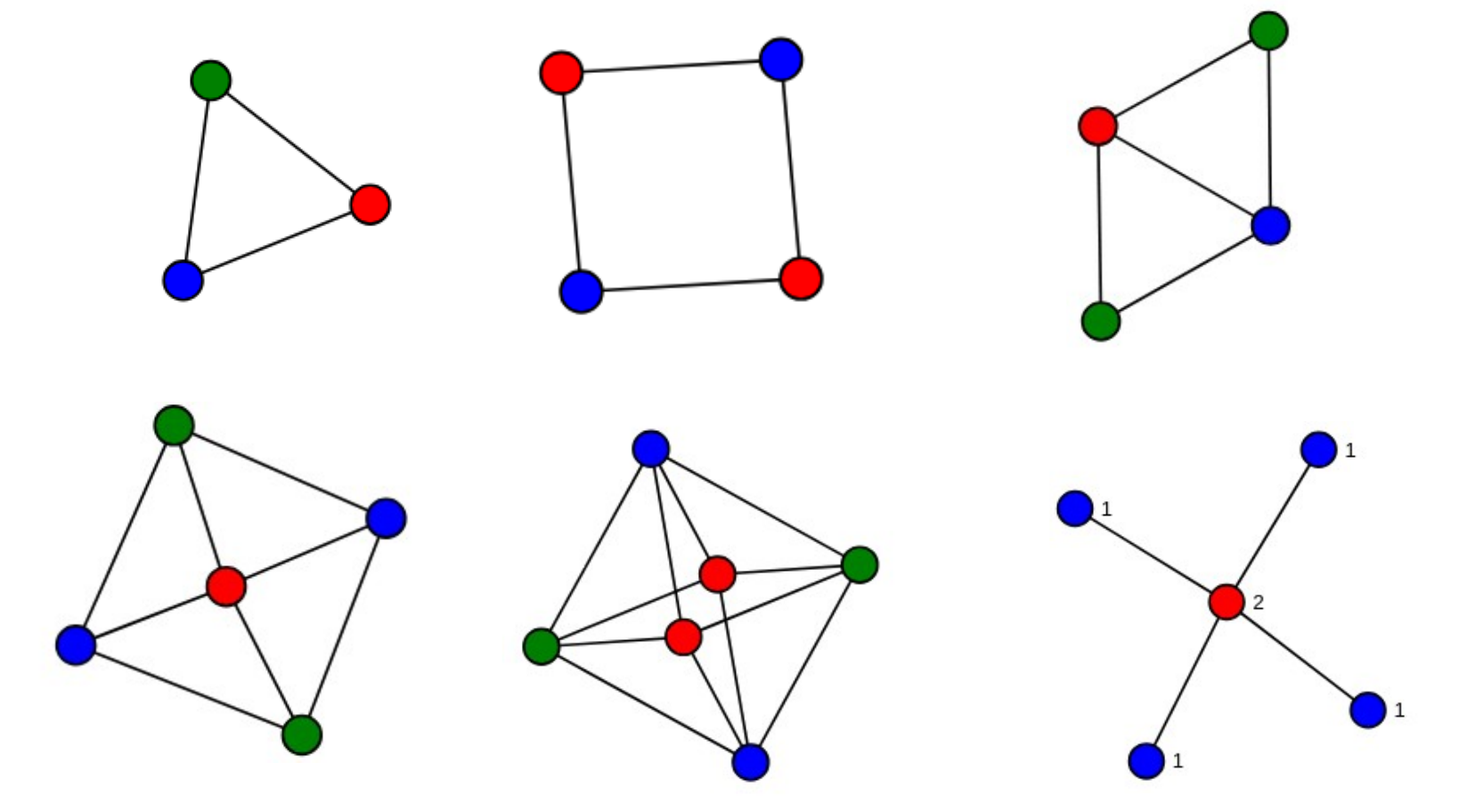
The examples here are the complete tripartite graphs: Use the arrows to change the sizes of the parts, and click "draw graph" to redraw.
This class of graphs were related to connection on curves in the papers:
[B08] P. B. Irregular connections and Kac-Moody root systems
June 2008 arxiv link
[B12] P. B. Simply-laced isomonodromy systems, Pub. Math. IHES 2012
(pdf)
building on the two papers:
[CB03] W. Crawley-Boevey, On matrices in prescribed conjugacy classes with no common invariant subspace and sum zero, Duke 2003
arxiv link
that, in effect, related star-shaped graphs to tame connections (Fuchsian systems),
and:
[O92] K. Okamoto, The Painevé equations and the Dynkin diagrams, Painlevé transcendents (Sainte-Adèle, PQ, 1990), NATO ASI Ser. B, Vol 278, pp.299-313.
which lists the Okamoto symmetry diagrams of the Painlevé equations (in the table p.306):
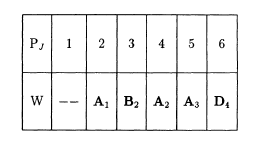
they are
the affine Dynkin diagrams determining the Okamoto symmetry groups of the Painlevé equations.
Each Painlevé equation has a standard Lax representation, which is a rank two linear meromorphic conection: the fission graph of this connection equals the Okamoto symmetry diagram,
for $\wh A_2,\wh A_3, \wh D_4$
(and $\wh A_1$ when you go beyond the simply-laced setting).
(Beware [O92] also considers some "dual" diagrams
p.310 row 6, which are generally different).
Before [B08, B12] the additive moduli spaces $\mathcal{M}^*$
for generic irregular connections appeared in:
[B01] P. B. Symplectic manifolds and isomonodromic deformations, Adv. Math. 2001 (pdf)
The star-shaped graphs occur if there are only two parts, one of size one.
E.g. parts of size $4,1,0$ gives the $\wh D_4$ graph; if you increase the dimension of the central node to $2$ in this case then the
moduli spaces have
dimension two and are the Painlevé 6 moduli spaces.
On the other hand, parts of sizes $2,2,0$ gives the Painlevé 5 moduli spaces
(coming from the square, $\wh A_3$), and $1,1,1$ gives the Painlevé 4 moduli spaces (coming from the triangle, $\wh A_2$).
They are the simplest non-star-shaped cases.
The Betti moduli spaces $\MB(\Gamma, \bd)$ (wild character varieties) are multiplicative quiver varieties in the sense of:
[B15] P.B. Global Weyl groups and a new theory of multiplicative quiver varieties, Geometry and Topology 2015, arxiv link
In the star-shaped cases these multiplicative quiver varieties coincide with the classical definition
stemming from the works listed below,
but in general the new multiplicative quiver varieties $\MB(\Gamma, \bd)$ are not isomorphic to
classical multiplicative quiver varieties
(see [B15] Prop. 6.8):
[CB-S06] W. Crawley-Boevey, and P. Shaw, Multiplicative preprojective algebras, middle convolution and the Deligne-Simpson problem. Adv. Math. 201, no. 1 (2006) 180-208 arxiv link
[GMV96] S. Gelfand, R. MacPherson and K. Vilonen,
Perverse sheaves and quivers, Duke Math. J. 83 no. 3 (1996) 621–643
[M91] B. Malgrange, Équations différentielles à coefficients polynomiaux,
Progress in Math. Vol. 96 1991 (Thm 3.1, p.31)
[M88] P. Maisonobe,
Faisceaux pervers sur $\IC$ relativement à $\{0\}$ et couple $u:E{\rightleftarrows}F:v$,
Introduction à la théorie algébrique des systèmes différentiels (Plans-sur-Bex, 1984),
Travaux en Cours vol.34,
pp. 135–146, Hermann, Paris, 1988
[BdM83] L. Boutet de Monvel, $\cD$-modules holonomes régulieres en une variable, Séminaire E.N.S. 1979-82, Progress in Math. Vol. 37 1983, pp.313-321
Exercise:
Show that the tetrahedral graph $1111$ (with four parts, each of size $1$) leads to a moduli space of dimension $6$.Some simple examples:
| Name | Part sizes | Dimension | Remarks |
|---|---|---|---|
| Triangle $\wh A_2$ | $1,1,1$ | $2$ | Painlevé $4$ |
| Square $\wh A_3$ | $2,2,0$ | $2$ | Painlevé $5$ |
| Diamond | $1,1,2$ | $4$ | |
| Pyramid | $1,2,2$ | $8$ | |
| Octahedron | $2,2,2$ | $14$ | |
| Four-pointed star $\wh D_4$ | $1,4,0$ | $2$ | Painlevé $6$, with dimension $2$ at central node |